
Sterling, VA · Garage Door Service
Why Cold Weather Breaks Springs on Sterling Garage Doors
Sterling's housing stock dates mostly to the 1980s and 90s, and cold snaps hit torsion springs hard. Here's what changes, what breaks, and what to check first.
- Repairs & new doors
- Springs & openers
- Serving 5 nearby communities
What Changes With the Season
Steel contracts when it gets cold, and a torsion spring is just coiled steel under constant tension. As the temperature drops, the metal stiffens and loses some of the flex it has at 70 degrees. The spring that wound and unwound a thousand times without complaint in August starts to feel the strain in January. This matters more here than in a mild climate, because Sterling sits in a cold-severe band, not a mild one. A spring near the end of its life that might have limped through another few months somewhere warmer can snap on the first hard freeze here instead. Most of the housing around Sterling went up between 1938 and 2015, with the bulk of it dating to the 1980s and 90s across the area's named neighborhoods. That means a lot of original or first-replacement springs are now thirty to forty years old, right at the point where age and cold weather start working against each other at the same time. If your door has felt heavier or noisier the last few cold mornings, that's not your imagination. That's the metal telling you something.
The Problem
A torsion spring breaks under tension, not because something falls on it. Cold makes the steel more brittle, and a spring with thousands of cycles on it already has microscopic fatigue in the coil. Add the extra stiffness of a hard freeze and the stress point that was holding for years finally lets go. It usually happens in the early morning, the first time the door gets opened after an overnight cold snap. This is also when the 1980s-era doors common around Sterling tend to show their age. Those spring setups weren't built to last forever, and nobody's expecting to replace a 40-year-old torsion spring - until it breaks on a 15-degree morning and the car is stuck inside. The honest limit here: we can't tell you if your spring will break this winter or hold for five more. There's no inspection that promises that. What we can tell you is that a spring already past 10,000 cycles, in a house built in that mid-century boom era, is not a spring we'd bet on through a hard winter.
What to Check
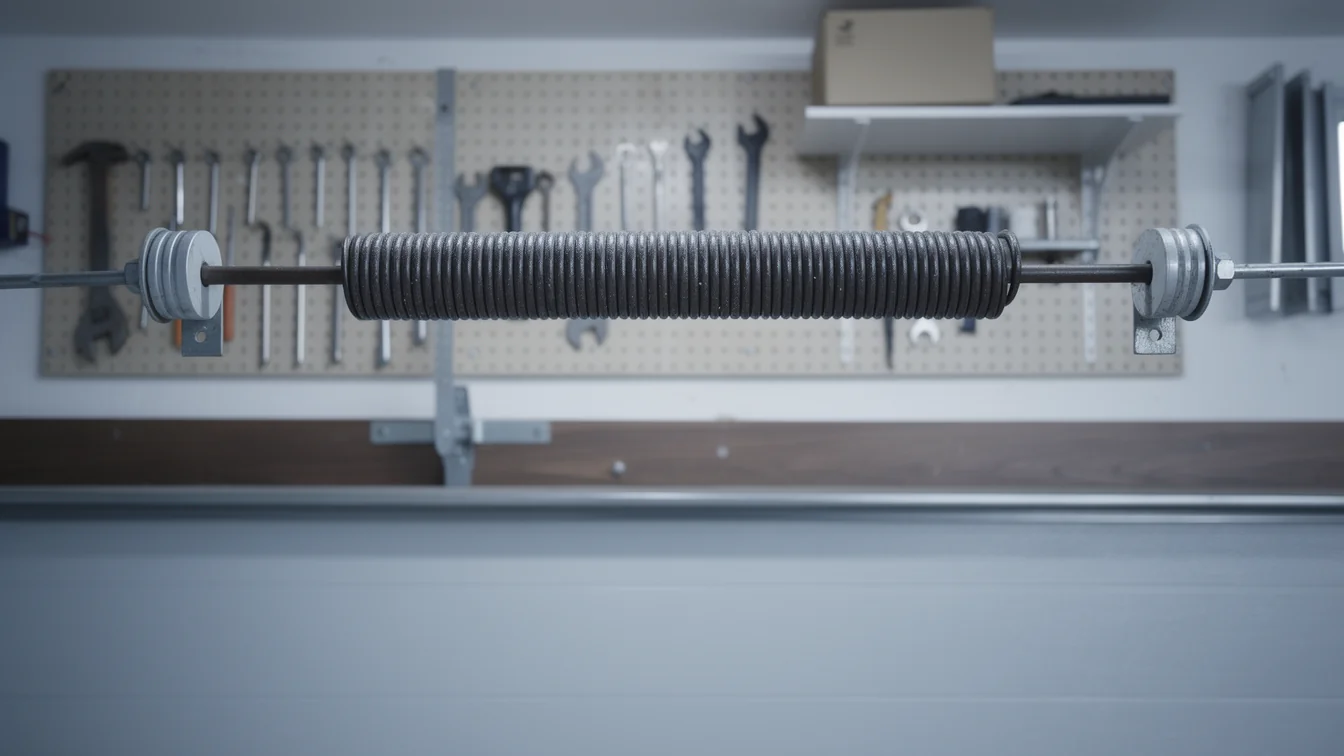
Look at the spring itself first - it's the one or two coiled bars above the door, not the cables on the sides. A gap in the coil means it's already broken; don't try to open the door. Short of that, check for rust on the coils, which speeds up metal fatigue, and listen for a grinding or popping sound as the door moves, which often shows up before a full break. Check the date or install sticker if your garage still has one; a lot of Sterling area homes built in that 1980s-90s stretch never had the original spring swapped, which puts that spring well past its expected life. Also check how the door feels when you lift it by hand with the opener disconnected - it should feel close to balanced, not like dead weight. A door that slams down or won't stay at knee height is telling you the spring has already lost most of its tension, cold weather or not.
What the Weather Here Does to It
Sterling falls in a cold-severe climate band, which means real freeze-thaw cycles each winter, not just an occasional cold snap. That cycling is harder on steel and on the door itself than steady cold would be - the metal contracts, then expands, then contracts again, and each cycle adds a little more fatigue to a spring that's already stressed. It also affects the track and rollers, since moisture that gets in during a thaw can freeze again overnight and stiffen the whole system right when the spring is least able to handle extra resistance. None of this is unique to one house. It's the pattern across the area's housing, most of which was built well before today's weatherization standards. If you're hearing a new noise or feeling new resistance on cold mornings, that's worth a look before the forecast turns colder, not after.
Frequently asked questions
Why did my spring break on such a cold morning?
Cold steel is more brittle, and a spring that's already fatigued from years of cycles reaches its breaking point faster in a hard freeze. It's almost always the first lift of the day after an overnight cold snap, when the metal is at its stiffest and the accumulated wear finally gives out.
How old is too old for a torsion spring in this area?
We can't give you an exact year, since it depends on cycles and use, not just age. But a lot of homes in the area date to the 1980s and 90s, and a spring from that era that's never been replaced is well past the point where cold weather becomes a real risk.
Can I just wait until spring to replace a worn spring?
That's the riskiest time to wait, honestly. Cold weather is exactly when a tired spring is most likely to fail. If you're already seeing signs of wear, waiting out the winter is the opposite of what the metal wants.
Is it the cold or just old age that breaks springs?
Usually both together. Age brings fatigue to the coil, and cold weather removes the flexibility that was masking that fatigue the rest of the year. A spring near the end of its life in a mild month can go another spring and summer; the same spring often doesn't survive the first real freeze.
Related garage door services in Sterling
More garage door guides
Book garage door service in Sterling
Call now or request a quote - tell us what the door is doing and where you are.